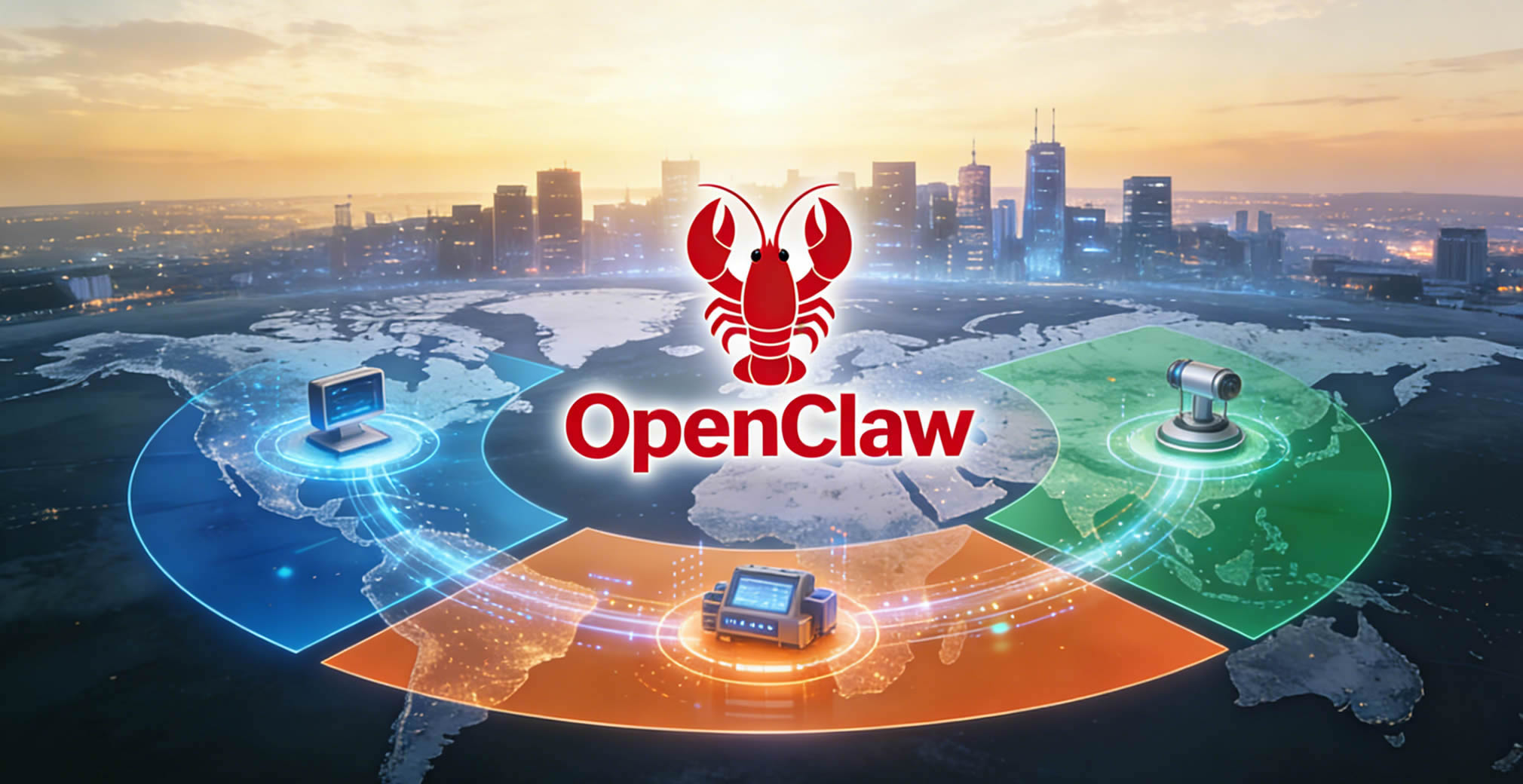
At the start of 2026, OpenClaw, featuring its iconic red lobster logo, swept the global tech camp. This open-source AI agent framework surpassed 260,000 stars on GitHub in just 4 months and attracted over 2 million weekly visitors, earning praise from NVIDIA CEO Jensen Huang as "one of the most influential technological breakthroughs of the era."
From the nationwide "lobster farming" frenzy in China, to the collective ban by European and American tech giants, and the cautious follow-up in Japan, South Korea, and Southeast Asia, OpenClaw has shown distinctly different development trends around the world. As a core carrier for the implementation of AI agents, it has not only ignited a new game of global technological competition but also hidden risks that spread across regions. Based on an international perspective, this article analyzes the global development pattern, core risks, and future trends of OpenClaw, suitable for video interpretation scenarios, balancing professionalism and popularity to ensure readers with different knowledge backgrounds can understand it clearly.
The global development of OpenClaw clearly presents three major camps, with particularly prominent regional differentiation. The first camp is China, showing an explosive growth trend of "policy support + industrial boom." Cities such as Shenzhen and Wuxi took the lead in introducing ten-million-level special subsidies; tech giants like Tencent and Alibaba Cloud quickly launched one-click deployment services; enterprises such as UCloud and Rockchip accelerated the construction of a complete industrial chain around cloud deployment and chip adaptation; AI manufacturers like Moonlight AI rose rapidly, with revenue in just 20 days exceeding the entire year of 2025, and overseas market contribution accounting for over 50%. Currently, Chinese users account for nearly half of the global OpenClaw downloads, and the browsing volume of Chinese documents far exceeds that of other non-English languages. The "lobster farming" craze has quickly penetrated from the geek circle to multiple scenarios such as personal office, enterprise operation, and government services.
The second camp is the European and American regions, showing a cautious development trend of "giant bans + tightened regulation." Anthropic took the lead in prohibiting the use of Claude accounts in OpenClaw; Google followed closely by mass banning users who improperly called Gemini; enterprises such as Meta and Cisco also issued security warnings, even explicitly prohibiting employees from deploying the tool on work devices. The core reason is that OpenClaw's multi-user sharing model directly impacts the subscription-based profit logic of European and American tech manufacturers; at the same time, the EU AI Act and the U.S. NIST (National Institute of Standards and Technology) agent standard initiative both emphasize security auditing and liability division, forcing enterprises to improve risk control systems before promoting technology deployment, forming a prudent development path of "regulation first, application later."
The third camp is emerging markets such as Japan, South Korea, and Southeast Asia, showing a transitional state of "following the trend + inadequate adaptation." Driven by the global "lobster farming" craze, these regions have seen individual users deploying the tool following the trend and small and medium-sized enterprises trying to reduce costs and increase efficiency, but they also face practical problems such as high technical thresholds, lack of locally adapted plug-ins, and weak security protection systems. Among them, Japan and South Korea focus on localized transformation and actively launch customized versions adapted to local languages and office scenarios; while Southeast Asia is highly dependent on technical support from China, Europe, and the United States, and has not yet formed an independently controllable ecological system, with relatively backward overall development.
Although the development paths of various regions around the world are completely different, the core risks faced by OpenClaw are highly consistent, and several cross-border security incidents have occurred. Security risks are undoubtedly a global common pain point: among the 135,000 publicly exposed OpenClaw instances worldwide, 63% have exploitable security vulnerabilities; high-risk vulnerabilities such as CVE-2026-25253 have led to the loss of control of a large number of Agent credentials; malicious skill packs account for over 12%, which can directly steal user keys and deploy Trojan programs. From an OpenAI employee in the United States who lost 450,000 US dollars in digital currency due to prompt injection attacks, to a Chinese programmer whose API key was stolen, and then to user data leakage that have occurred in the Netherlands and South Korea, which all highlight the cross-regional transmission of such risks.
Compliance and commercial risks also plague practitioners around the world. Europe and America face dual pressures of data privacy protection and monopoly regulation, and OpenClaw's high-privilege access model is likely to violate relevant laws and regulations such as GDPR (General Data Protection Regulation); China focuses on addressing core issues of cross-border data transmission and trade secret protection; while emerging markets, due to the lack of relevant regulatory systems, are prone to falling into a "compliance vacuum" dilemma. At the commercial level, most enterprises worldwide have not yet formed a mature profit model. Problems such as high computing power costs, chaotic plug-in ecology, and intensified homogeneous competition have become "growing pains" of the global OpenClaw industry. In addition, the change of OpenClaw's founder joining OpenAI and the project being converted to an open-source foundation structure has brought new uncertainties to the subsequent development of the global ecosystem.
Looking ahead, in terms of the future trends of global OpenClaw, its development will gradually move from the current "wild growth" to "standardized collaboration," and three core directions have become increasingly clear. In the short term, the world will fully enter the development stage of "safety and compliance first": China will continue to improve the security protection system and local subsidy policies; Europe and the United States will accelerate the implementation of special regulatory rules for AI agents; emerging markets will gradually establish basic risk control systems; security reinforcement and log auditing will become essential standards for global OpenClaw deployment.
In the medium term, the differentiated development of regional ecosystems will become more obvious. China will accelerate the process of domestic substitution, focus on building an independently controllable ecological system of "domestic framework + local plug-ins," and further consolidate the industrial chain advantage; European and American regions will focus on the high-end enterprise market, focusing on customized security services and compliance solutions to highlight technical barriers; emerging markets such as Japan, South Korea, and Southeast Asia will promote scenario-based adaptation based on local actual needs and gradually narrow the development gap with leading regions. At the same time, the world will gradually form a diversified profit model of "subscription system + customized services," effectively solving the current commercial dilemma.
In the long term, OpenClaw will achieve global ecological collaborative development and gradually become the core infrastructure of the digital economy. Open-source communities and commercial enterprises will work together to promote the global unification of technical standards and security norms, and cross-regional plug-in interoperability and multilingual adaptation will become the industry norm. In the future, it will gradually integrate into various scenarios such as global enterprise office, industrial production, and government services, become the core infrastructure for digital economy development, promote in-depth integration of human-machine collaboration, and then reshape the global industrial efficiency pattern.
All in all, the global "lobster farming" frenzy triggered by OpenClaw is a landmark event for AI agents to move from concept to practical implementation—it not only carries the expectations of global technological innovation but hides common risks that spread across regions. In the future, competition and collaboration among countries around the world will coexist for a long time. Only by balancing technological innovation and risk control, accurately adapting to local needs, and promoting global ecological co-construction and sharing can this "lobster" agent truly serve global industrial upgrading and human well-being, and become a sustainable engine which will drive the high-quality development of the global AI industry.
Subscribe to Unlock this Article
Complete digital access to quality Glebors financial topic with expert analysis from industry leaders.
Glebors Financial Become an Glebors subscriber
Make informed decisions with the Glebors.Keep abreast of significant corporate, financial and political developments around the world. Stay informed and spot emerging risks and opportunities with independent global reporting, expert commentary and analysis you can trust.
- Financial reports are independent global financial research reports that you can trust. The information keeps pace with important companies around the world, global financial and political dynamics, independent insights and unique perspectives, helping you catch up with the latest information and identify the potential risks and opportunities.
- Our financial special reports use professional knowledge to fully understand the market situation, break down the perspectives of experts, and rationally analyze data to help you eliminate noise, accurately identify the changes in political, economic and social trends, and fully aware of the risks and grasp the opportunities.
- Our goal is to help shape the uniqueness of each research space we are involved in. Our research provides readers with new insights in terms of the global economy, financial markets, asset classes and risk management. We will continue to present new insights into global markets and industries.
Financial Reports
If you want to know more details to provide support for your investment and business activities, this financial report that we have selected for you can give you what you want, please subscribe to read it. Glebors Global Finance aims to provide business elites and decision makers with daily business news, data interpretation, in-depth analysis and commentary.
Glebors Global Finance’s amount of financial information digs into deeply major events and economic data that have a huge impact on the global economy, based on in-depth industrial research and special reports, with a truly global perspective。 Financial reports have become "must-read" financial information for senior managers. Gribs Global Finance currently has more than2.85 million Chinese readers and more than 3.5 million overseas readers, including more than 600,000 high-end member readers.